Home / Products / Flood Light Poles
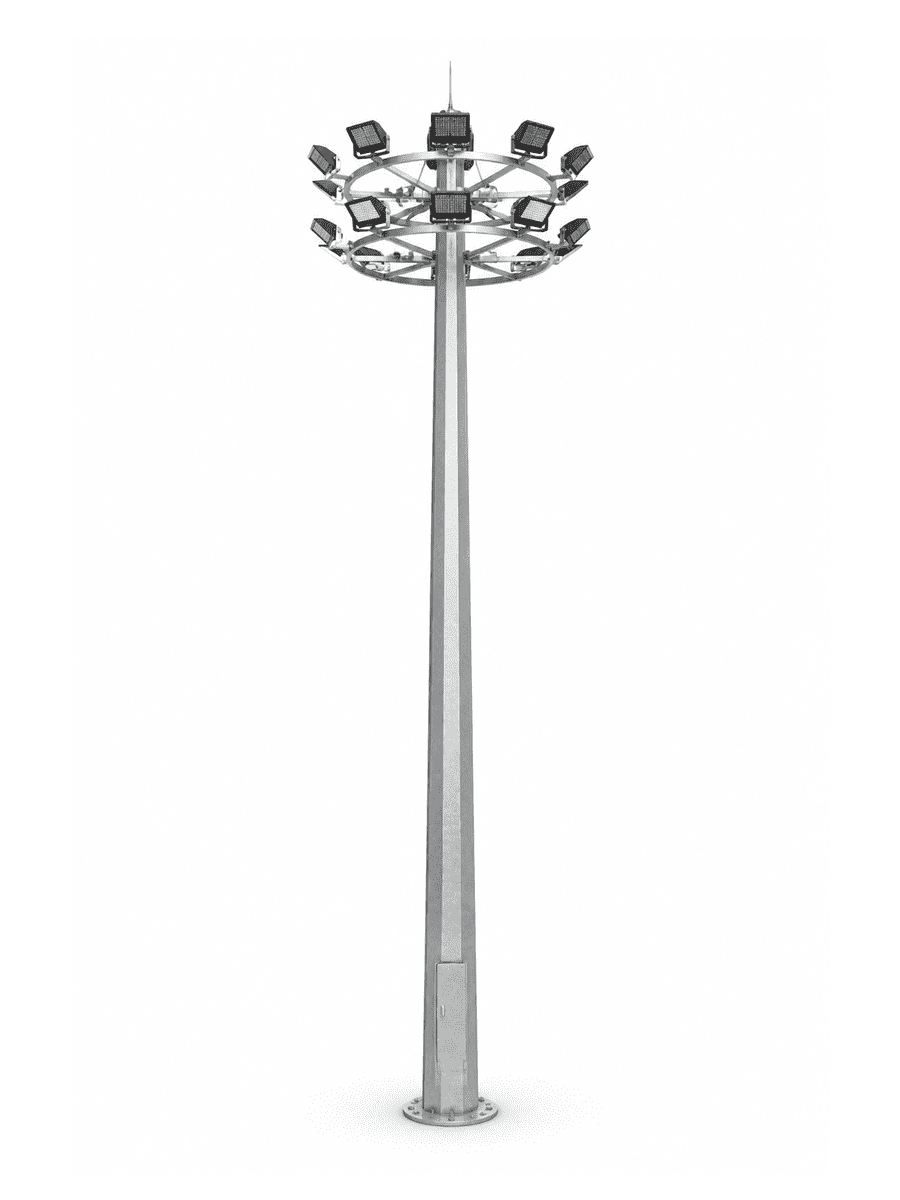
Double Tier High Mast, 8–16 Floodlights
Double Tier high mast light carrying 16 floodlights, on a hot-dip galvanised steel pole supplied with the base plate, the anchor bolts and the foundation drawing.
- Section: Round conical (tapered round) steel pole
- Crown type: Fixed crown
- Crown frame: Double Tier frame carrying 16 floodlights
- Standard heights: 15 m to 30 m; other heights produced to the project drawing
- Material: Steel Q235 or Q355
- Finish: Hot-dip galvanised as standard
- Supplied with: Base plate, anchor bolts, earthing terminal and foundation drawing
- Mounting: Crown frame welded to the pole top and drilled ready for the floodlights
Request a quotation for Double Tier High Mast, 8–16 Floodlights
Quantity, destination port and your contact details are enough for us to price it. Tell us the pole height or road class if you have them.
Double Tier high mast lights are specified where a large area has to be lit from a single point — stadiums, ports, freight yards, highways and industrial sites. This pole carries a double-tier crown frame with 8 or 16 floodlights, so the whole area is covered from one foundation.
The pole is delivered hot-dip galvanised with the base plate welded on, the anchor bolts and the foundation drawing. The crown frame is drilled to match the floodlight brackets, and the pole door gives access to the wiring and the earth terminal.
At a glance
| Section | Round conical (tapered round) steel pole |
| Crown type | Fixed crown |
| Crown frame | Double Tier frame carrying 16 floodlights |
| Standard heights | 15 m to 30 m; other heights produced to the project drawing |
| Material | Steel Q235 or Q355 |
| Finish | Hot-dip galvanised as standard |
| Supplied with | Base plate, anchor bolts, earthing terminal and foundation drawing |
| Mounting | Crown frame welded to the pole top and drilled ready for the floodlights |
How to choose the head count
Two platforms at different heights on the same mast: eight heads as four plus four, or sixteen as eight plus eight. Splitting the heads vertically does what a double ring does horizontally — the upper tier reaches the perimeter, the lower tier fills the near field — but it separates the two light sources further apart, which reduces the hot spot where both beams overlap.
| Heads | Layout | Where it is usually specified | Watch |
|---|---|---|---|
| 8 | Four on each of two tiers | Mid-size yards where the base area must be lit as well as the perimeter | Two platforms to service, not one |
| 16 | Eight on each of two tiers — full ring coverage at two heights | Large freight yards, ports, terminals | Heaviest crown in this group; foundation follows the load |
The vertical gap between tiers is a design decision, not a standard: too close and the two beams merge into one hot spot, too far apart and the mast needs more section for the same load. It has to be agreed against the luminaire's beam angle.
What changes in the design
Two platforms increase both the loaded weight and the projected wind area, and they place the load higher up the mast than a single platform with the same head count — which is worse for bending. The mast section, base plate and foundation are sized for the tier geometry, so the tier heights have to be fixed before the drawing is issued.
Standard construction: hot-dip galvanised Q235 or Q355, 15–30 m, base plate, door, cable entry, anchor bolts and foundation drawing. Ladder, lifting carriage or platform access are options; with two tiers, access arrangement is usually the deciding cost.
What to send with the enquiry
- Mast height and the two tier heights you expect.
- Area dimensions, and whether the mast stands inside the lit area.
- Luminaire weight and beam angle per tier.
- Access method for both tiers.
Crown types compared
The crown frame is welded to the pole top before galvanising, so the number of floodlights is fixed at order and cannot be increased on site. The table below compares the crown types we build; the row in bold is the range on this page.
| Crown frame | Floodlights | Access | Mounting note |
|---|---|---|---|
| Triangular | 3–9 | Fixed | Three faces at 120°; each added floodlight lengthens its arm |
| Ring Crown | 4–10 | Fixed, or ladder-access | Heads on a circular ring; the most common choice for yards and terminals |
| Double Ring | 12 | Fixed | Two concentric rings; more heads without lengthening a single arm |
| Single Side | 4–8 | Fixed | All heads on one side; used where the mast stands at the edge of the lit area |
| Hexagonal | 6–18 | Fixed | Six faces; carries the highest head count of the fixed crowns |
| Double Tier | 8–16 | Fixed | Two levels; the lower tier lights the base of the mast |
| Stadium Matrix | 6–12 | Fixed | Rectangular matrix frame aimed at a pitch or arena |
| Lifting Ring | 8–16 | Internal lifting device | Crown lowered to ground level for maintenance without a platform |
All crown types share the same mast specification: round conical section, Q235 or Q355 steel, hot-dip galvanised, 15–30 m standard heights, supplied with base plate, anchor bolts, earthing terminal and foundation drawing. Head counts outside the ranges shown are built to the project drawing.
Double Tier High Mast, 8–16 Floodlights — technical parameters
| Section | Round conical (tapered round) steel pole |
| Crown type | Fixed crown |
| Crown frame | Double Tier frame carrying 16 floodlights |
| Standard heights | 15 m to 30 m; other heights produced to the project drawing |
| Material | Steel Q235 or Q355 |
| Finish | Hot-dip galvanised as standard |
| Supplied with | Base plate, anchor bolts, earthing terminal and foundation drawing |
| Mounting | Crown frame welded to the pole top and drilled ready for the floodlights |
| Crown options | Fixed, ladder-access or internally lifting crown; RAL powder coating on request |
| Pole section | Diameter, wall thickness and base plate confirmed to the wind zone at your site |
Tell us the pole height, the number of floodlights, the mounting height and the wind zone and we will confirm the section, the wall thickness, the base plate and the anchor bolts for your project.