Home / Products / Flood Light Poles
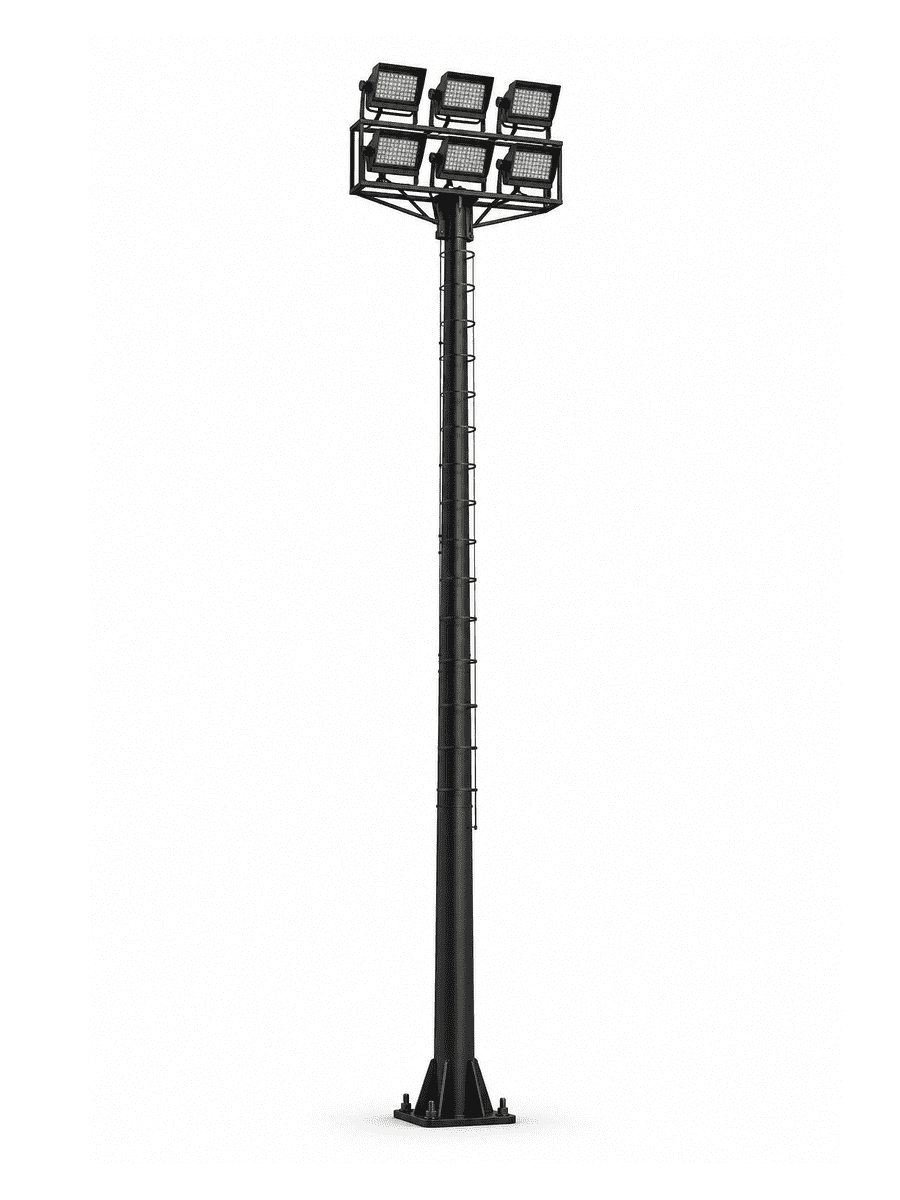
Hexagonal High Mast, 6–18 Floodlights
Hexagonal high mast light carrying 12 floodlights, on a hot-dip galvanised steel pole supplied with the base plate, the anchor bolts and the foundation drawing.
- Section: Round conical (tapered round) steel pole
- Crown type: Fixed crown
- Crown frame: Hexagonal frame carrying 12 floodlights
- Standard heights: 15 m to 30 m; other heights produced to the project drawing
- Material: Steel Q235 or Q355
- Finish: Hot-dip galvanised as standard
- Supplied with: Base plate, anchor bolts, earthing terminal and foundation drawing
- Mounting: Crown frame welded to the pole top and drilled ready for the floodlights
Request a quotation for Hexagonal High Mast, 6–18 Floodlights
Quantity, destination port and your contact details are enough for us to price it. Tell us the pole height or road class if you have them.
Hexagonal high mast lights are specified where a large area has to be lit from a single point — stadiums, ports, freight yards, highways and industrial sites. This pole carries a hexagonal crown frame with 6, 12 or 18 floodlights, so the whole area is covered from one foundation.
The pole is delivered hot-dip galvanised with the base plate welded on, the anchor bolts and the foundation drawing. The crown frame is drilled to match the floodlight brackets, and the pole door gives access to the wiring and the earth terminal.
At a glance
| Section | Round conical (tapered round) steel pole |
| Crown type | Fixed crown |
| Crown frame | Hexagonal frame carrying 12 floodlights |
| Standard heights | 15 m to 30 m; other heights produced to the project drawing |
| Material | Steel Q235 or Q355 |
| Finish | Hot-dip galvanised as standard |
| Supplied with | Base plate, anchor bolts, earthing terminal and foundation drawing |
| Mounting | Crown frame welded to the pole top and drilled ready for the floodlights |
How to choose the head count
A hexagonal crown gives six faces, so the head count runs 6, 12 or 18 — one, two or three lamps per face. Six faces put more aiming points around the mast than a triangular crown, which is what a large open area needs: the gaps between beams close up and the perimeter stops showing scallops.
| Heads | Layout | Where it is usually specified | Watch |
|---|---|---|---|
| 6 | One lamp per face — even coverage, modest crown weight | Mid-size yards, car parks, plant compounds | The cheapest way to get true 360-degree coverage |
| 12 | Two per face — near and far throw on every direction | Large logistics yards, port storage areas | Most specified size in this family; crown weight climbs sharply |
| 18 | Three per face — maximum evenness at the outer edge | Stadium surrounds, major transport hubs, large terminals | Heaviest option here; platform, lifting and foundation all change |
Going from 12 to 18 heads rarely doubles the useful light on the ground — it mostly raises the evenness at the perimeter. If the outer edge is still dark at 12 heads, the usual cause is mast height against area size, not head count.
Why six faces rather than a ring
The faces are flat, so each luminaire mounts against a plane and its aim is set against that plane rather than a curve. On a multi-mast installation that makes the aiming repeatable from mast to mast, which is the reason hexagonal crowns appear on terminals and ports where consistency across a large site matters more than the appearance of any single mast.
Construction is the same as the rest of the high mast range: hot-dip galvanised Q235 or Q355, 15–30 m, base plate, door, cable entry, anchor bolts and foundation drawing supplied, with sectional or tapered shaft and ladder or lifting carriage as options.
What to send with the enquiry
- Mast height and the area to be covered, drawn if possible.
- Required evenness at the perimeter — this is what decides 6, 12 or 18.
- Luminaire weight and beam angle per head.
- Access method: ladder, lifting carriage or platform.
Crown types compared
The crown frame is welded to the pole top before galvanising, so the number of floodlights is fixed at order and cannot be increased on site. The table below compares the crown types we build; the row in bold is the range on this page.
| Crown frame | Floodlights | Access | Mounting note |
|---|---|---|---|
| Triangular | 3–9 | Fixed | Three faces at 120°; each added floodlight lengthens its arm |
| Ring Crown | 4–10 | Fixed, or ladder-access | Heads on a circular ring; the most common choice for yards and terminals |
| Double Ring | 12 | Fixed | Two concentric rings; more heads without lengthening a single arm |
| Single Side | 4–8 | Fixed | All heads on one side; used where the mast stands at the edge of the lit area |
| Hexagonal | 6–18 | Fixed | Six faces; carries the highest head count of the fixed crowns |
| Double Tier | 8–16 | Fixed | Two levels; the lower tier lights the base of the mast |
| Stadium Matrix | 6–12 | Fixed | Rectangular matrix frame aimed at a pitch or arena |
| Lifting Ring | 8–16 | Internal lifting device | Crown lowered to ground level for maintenance without a platform |
All crown types share the same mast specification: round conical section, Q235 or Q355 steel, hot-dip galvanised, 15–30 m standard heights, supplied with base plate, anchor bolts, earthing terminal and foundation drawing. Head counts outside the ranges shown are built to the project drawing.
Hexagonal High Mast, 6–18 Floodlights — technical parameters
| Section | Round conical (tapered round) steel pole |
| Crown type | Fixed crown |
| Crown frame | Hexagonal frame carrying 12 floodlights |
| Standard heights | 15 m to 30 m; other heights produced to the project drawing |
| Material | Steel Q235 or Q355 |
| Finish | Hot-dip galvanised as standard |
| Supplied with | Base plate, anchor bolts, earthing terminal and foundation drawing |
| Mounting | Crown frame welded to the pole top and drilled ready for the floodlights |
| Crown options | Fixed, ladder-access or internally lifting crown; RAL powder coating on request |
| Pole section | Diameter, wall thickness and base plate confirmed to the wind zone at your site |
Tell us the pole height, the number of floodlights, the mounting height and the wind zone and we will confirm the section, the wall thickness, the base plate and the anchor bolts for your project.